Why choose Reaction Injection Molding? The answer often begins with the part itself: a broad instrument panel, a lightweight equipment housing, or a molded component with ribs and inserts. Reaction Injection Molding combines liquid reactive materials inside a closed mold, where they cure into a solid part. This process can suit large, detailed components that would be challenging or costly to produce using other methods.
Its appeal is practical. Compared with conventional injection molding, RIM commonly uses lower injection pressures, which can allow lighter tooling. Designers may also integrate features that would otherwise require separate assembly. The result can be fewer parts and less handling. But it is not a shortcut. Material selection, mold temperature, mixing, and cure time all affect the finished component. A small process variation can leave visible defects or uneven properties.
Plastics-processing author Dr. James L. Throne’s work offers a useful perspective. A paraphrase of its core lesson is: “Material, tooling, and process control must work together.” That is not a direct quotation; it summarizes a central manufacturing principle. Before choosing RIM, teams should compare part geometry, expected production volume, material performance, and tooling cost. A sample panel can reveal surface and fit issues early. It may also expose assumptions that looked sound on paper. RIM can be an effective choice, but only when the process fits the product—not the other way around.
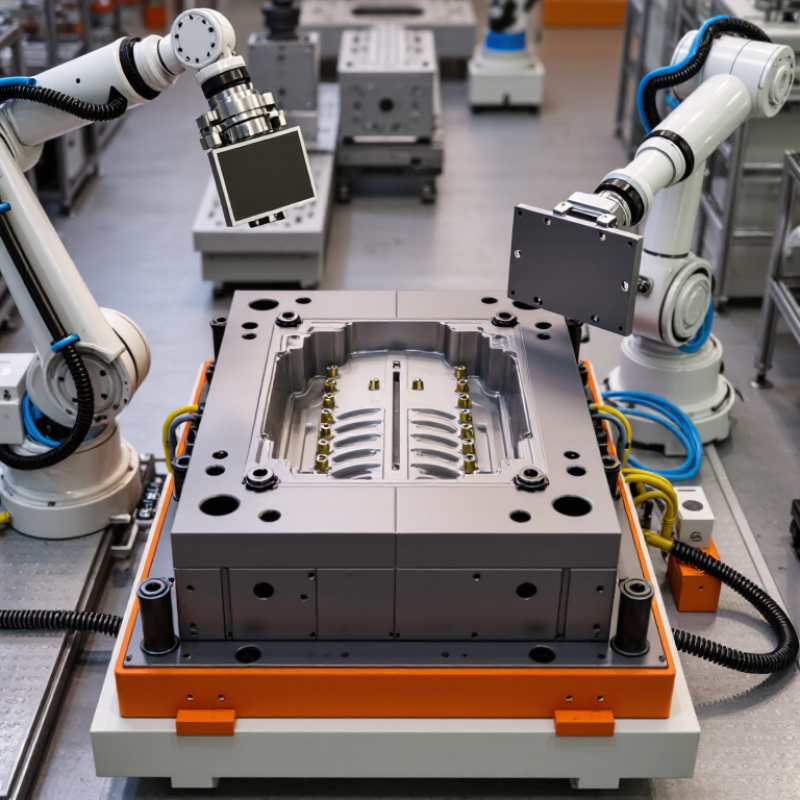
Reaction injection molding (RIM) forms a part by mixing reactive liquid components and injecting them into a closed mold. The mixture reacts and cures inside the tool. Polyurethane is a common RIM material. Unlike conventional thermoplastic injection molding, RIM uses low-viscosity liquids before curing. This can help fill large cavities and detailed features, such as deep ribs or curved panels. The result depends on the formulation, mold design, and process control.
Grand View Research’s 2023 polyurethane market report estimated the global polyurethane market at USD 78.1 billion in 2022, with projected growth of 6.2% annually from 2023 to 2030. This figure covers polyurethane broadly, not RIM alone. It signals a substantial material sector, but it does not prove RIM is right for every part. RIM can suit larger components and lower-volume production, though cure time and surface finish need careful testing. A missed detail: results can vary with temperature and mixing, even when the mold stays unchanged.

Reaction injection molding begins with two liquid components, commonly a polyol and an isocyanate. Metering equipment delivers them in controlled proportions. They meet in a mixing head, then enter a closed mold as a low-viscosity mixture. The chemistry starts quickly. The material reacts, expands where specified, and cures into a solid part. After cooling, operators open the mold and remove the component for inspection or finishing. Unlike conventional thermoplastic injection molding, the process relies on a chemical reaction inside the tool. That makes formulation and timing critical. A slight temperature shift can change flow or cure behavior; real production needs trials, not assumptions.
The scale of polyurethane use helps explain the process’s industrial relevance, though market growth alone does not prove it suits every part. MarketsandMarkets’ 2023 Polyurethane Market report estimated the global market at USD 78.1 billion in 2023 and projected USD 101.8 billion by 2028. RIM can be useful for larger, complex parts, including housings and panels, where a lower-viscosity mix can fill detailed mold sections. Engineers still need to check wall thickness, venting, mold temperature, and material shrinkage. These details are easy to underestimate. A poorly balanced mix or blocked vent can leave voids, uneven surfaces, or inconsistent dimensions. That is the less glamorous side of the process—and a good reason to validate the part design and process settings before production.
Why Choose Reaction Injection Molding?
Key Advantages of Reaction Injection Molding
Reaction injection molding is useful for medium-to-large polymer parts with detailed geometry. Two reactive liquid components mix and enter a closed mold. The process uses relatively low pressure, which can make tooling less demanding than high-pressure molding. It supports broad panels, molded-in ribs, and smooth surfaces. Less force is needed. Parts can also have varying wall thicknesses, though careful design remains important.
Material flexibility is another advantage. Formulations can be selected for impact resistance, stiffness, or a soft-touch feel. Metal inserts can be placed in the mold and surrounded by the reacting material, potentially reducing assembly steps for equipment covers or interior panels. Still, RIM is not a cure-all. Cure time, temperature, and mixing affect consistency. Poor process control may cause uneven surfaces or weak areas. Tooling can be economical for some designs, but not every production volume or tolerance.
Tips: Define strength and finish requirements before choosing a formulation. Review wall transitions and vent locations with a process engineer. Test sample parts under realistic conditions. A rushed prototype can hide problems.
| Dimension | How Reaction Injection Molding Works | Key Advantage | Important Consideration |
|---|---|---|---|
| Material processing | Reactive liquid components are mixed and injected into a mold, where they undergo a chemical reaction and cure. | The process can use low-viscosity materials, which flow into the mold before curing. | Material formulation, mixing, temperature, and cure conditions must be carefully controlled. |
| Tooling requirements | RIM commonly uses lower-pressure injection than conventional thermoplastic injection molding. | Lower injection pressure can allow lighter, less costly tooling for suitable applications. | Tool design and material choice still affect cost, durability, and achievable production volume. |
| Part size | The process can produce large molded components, depending on the equipment, material system, and mold design. | It can be practical for sizable parts that would require substantial equipment or tooling for other processes. | Large parts may require attention to filling, cure uniformity, handling, and dimensional control. |
| Part geometry | Liquid reactants can fill complex mold cavities, including designs with curved surfaces and varying wall sections. | Design flexibility can support integrated features and distinctive shapes. | Geometry must be designed around flow, venting, shrinkage, and the specific material system. |
| Part weight | Some RIM material systems, such as polyurethane systems, can be formulated to produce relatively lightweight components. | Lower part mass may be useful where weight reduction is a design priority. | Weight and mechanical performance depend on the formulation, part structure, and design. |
| Mechanical properties | Material properties can be tailored through formulation; certain systems can provide toughness, flexibility, or impact resistance. | Properties can be matched to the functional requirements of the part. | No single RIM material provides every property; testing is needed to confirm performance in use. |
| Surface and finishing | Parts can be molded with a range of surface textures, and some formulations can support paintable or finished surfaces. | Molding may reduce the need for certain secondary finishing steps. | Surface quality depends on the mold, process control, material, and any required coating or finishing. |
| Production suitability | RIM is used for made-to-order components and production runs where its material and tooling characteristics are appropriate. | It can offer a useful balance of design flexibility and tooling investment for some applications. | Cycle time and economics vary by part, cure time, labor, equipment, and production volume; compare processes for each project. |
Why Choose Reaction Injection Molding?
Materials and Products Suited to Reaction Injection Molding
Reaction injection molding (RIM) suits parts made from reactive, low-viscosity liquid materials. Polyurethane systems are common, with formulations that produce rigid, flexible, or elastomeric parts. The liquid mixture fills a mold before curing, making it useful for larger components with curved surfaces, ribs, or integrated details. Think of a sturdy equipment cover with a textured face and mounting points formed in one piece.
Material choice depends on the job. Rigid polyurethane can provide structure for housings and panels, while flexible formulations can absorb impact or vibration. Some systems offer insulation or weather resistance, but performance varies by formulation and part design. A material that works well on a sample may behave differently in a thick section. Test the actual geometry.
Tips: Confirm chemical compatibility, expected temperatures, and load conditions with a qualified materials specialist. Check wall thickness and cure behavior before finalizing the mold. Small details matter. And RIM is not automatically the best fit: very high-volume, thin-walled parts may call for another process.
Typical elongation-at-break ranges for polyurethane RIM materials
Flexible polyurethane RIM is suited to impact-absorbing parts such as automotive fascia and protective covers. Rigid polyurethane RIM is used for stiff parts such as equipment enclosures and structural panels. Values are indicative typical ranges; actual properties vary by formulation and test method.
Reaction injection molding is worth considering when a part is large, geometrically complex, or difficult to produce with conventional high-pressure molding. The process injects reactive liquid components into a closed mold, where they form a polymer. It can accommodate thick sections, molded-in ribs, and features such as mounting points. That matters. For low-to-medium production volumes, lower mold pressure can also make large-part tooling more practical.
The U.S. Department of Energy’s “Lightweight Materials for Cars and Trucks” report estimates that a 10% reduction in vehicle weight can improve fuel economy by 6–8%. That is not a guaranteed RIM benefit: results depend on material choice and part design. RIM may help create lightweight, integrated components, but it is not automatically the best option. Tight tolerances, high production volumes, or demanding surface finishes may favor another process. One point deserves a second look: a large part is not, by itself, a reason to choose RIM.
Tips: Compare the full part, not just the molding step. Check annual volume, wall thickness, tolerance needs, and finishing work with a process engineer before committing to tooling.